Long neck Karen

Lastly on our jam packed day trip of Chiang Rai and northern Thailand is one of the more controversial elements of the trip. A visit to the Long Necked Karen tribe. These people fled from Burma in the 1980s and 1990s due to the military regime.

This is some thing that on one hand I desperately wanted to see because of the interesting characteristics and distinctive look of the tribe.

However on the other hand I have heard that it is little more than a human zoo with the people basically unable to leave due to their refugee status and money making potential.

We decided, in the end to visit and see for ourselves.

P1140612

The light was beginning to fade as we entered the village and the rain was setting in, so the ladies had all retired inside their wooden huts and donned jumpers and sweaters.

However, their distinctive neck ornamentation is still very much in evidence. Here are some of the tribal elders, including the woman with the most rings in the village.

P1140582
P1140589
P1140588

Women of the Long neck Karen or Padaung tribe begin wearing rings around the age of five.

They are not, as I originally thought, individual rings, but actually one long length of wire that is carefully coiled around the neck.

P1140591
P1140587
P1140592

Over the years the coil is replaced by a longer one and more turns are added. The weight of the brass pushes the collar bone down and compresses the rib cage.

The neck itself is not lengthened; the appearance of a stretched neck is created by the deformation of the clavicle. They also sometimes wear coils on their legs, just below the knees.

P1140596
P1140598
P1140600

There has been concern about the treatment of these tribes in Northern Thailand due to refusal to allow the registered  refugees to take up offers of resettlement in developing countries.

The tribes have made a lot of money for unscrupulous business men who charge people to visit the villages. I believe the resettlement policy is being relaxed and some people have since  left for other countries.

I did feel uncomfortable visiting the village I have to admit. The women seemed unhappy at having to spin and smile for tourists.

They seemed like bright butterflies trapped in a scenic cage. It may have been the end of a long day for them, or it might have hinted at a deeper unease.

P1140613

Mae Sai, as far north as you go

Mae Sai is the northernmost district of Chiang Rai and indeed Thailand. The town of Mae Sai is a major border crossing between Thailand and Burma.

P1140525 P1140528

We were able to see the border, tantalisingly close, just a five minute walk across a bridge! As it was, here’s the nearest we got to the enigmatic country of Myanmar.

P1140526 

Of course, there were also markets to be explored, but we only had a very short time before we headed off again, so here’s a whistlestop tour!

P1140535

I am always intrigued by the boxes, bags and packets of dried seeds, mushrooms and other exotic edibles.

P1140543

There’s always an elephant somewhere!

P1140548

As well as vendors carrying goods  . . .

P1140552

And here’s a few more stall holders. Some looking happier than others

P1140553 P1140569P1140574

. . . . . apologies for the brevity of the post!

P1140559

Golden Triangle

After ooohing and ahhhhing at the White Temple (and having to be bodily dragged away from it) we headed onto the area known as the Golden Triangle.

It’s where Thailand, Burma and Laos meet. Historically the Golden Triangle has been an area well-known for the growing of opium, and apparently the name comes from a US State Department memo about the practice.

P1140458

Most of the world’s heroin came from the Golden Triangle until the early 21st century when Afghanistan became the world’s largest producer.

We hopped on a boat to do a brief exploration of the area, which to be honest is a tiny bit boring!! The highlight for me was nipping across to a small island named Don Sao, belonging to Laos and getting a faux stamp in my passport (hey, I was in Laos, albeit for half an hour!)

P1140481  P1140496

Got a picture of me next to another country sign? Check!!

P1140501

Here’s a few unfortunate animals in jars – snake, scorpion and gecko whisky. Blah!

P1140486

Not sure these would get through customs to be honest!

P1140504

Here’s the Laos immigration official giving me my faux stamp! (loving the beer bottle next to him)

P1140511

Next up we get as far North as its possible to go in Thailand. and more markets.

Fantasy at Wat Rong Khun

Next up is the treat I had been waiting for . . .  . Wat Rong Khun – better known to tourists as the White Temple.

It’s a modern, unconventional Buddhist temple in Chiang Rai that simmers in the sunlight as if it’s made of snow.

P1140297

I first heard about the temple during my first visit to Thailand about four years ago but didn’t have chance to see it.

Designed by Chalermchai Kositpipat in 1997 this is no traditional temple. It’s decorated with murals of modern day superheros, villains and events such as superman, Bin Laden, the burning trade towers and other iconic modern day images.

The perils of booze are advertised in the most terrifying way ever while shrunken heads of Pinhead and other monsters swing in the breeze. Meanwhile Predator attempts to extricate itself from the ground much to the terror of small children.

P1140287
P1140293
P1140415
P1140423

It’s a fairy tale, sugar spun white confection of weirdness with a dark under belly.

Much of the temple’s messages refer to escaping earthly desires and greed and moving towards the sublime through Buddhist teachings. To physically demonstrate this you have to cross a sea of beseeching hands in purgatory, over the bridge to nirvana.

P1140313
P1140319
P1140324
P1140326

Departing from the usual gold of traditional Thai temples, Chalermchai chose to construct the temple in white, representing the purity of Lord Buddha. The results seem like surreal scenes moulded out of cake icing!

P1140331
P1140335
P1140350
P1140353

The twinkling mirrors embedded in the structure reflect the sunlight, reminding visitors of Buddha’s wisdom shining out across the world. (Plus some rather creepy demons coming at you too!)

P1140442
P1140375
P1140369

Another interesting feature of the temple are the intricate, beautiful prayer trees that are made up of thousands of delicate metallic chimes with wishes and hopes written on them.

P1140383
P1140390
P1140381

The temple shimmers under the blue skies. An other worldly vision of loveliness.

P1140406

While most of the temple is white, the designer chose to make the toilet block gold! It’s all to do with people and their worldly desires and needs! (Not sure what colour the actual loo roll was!)

P1140411
P1140412
P1140418

Hot springs and heading north.

Another of our day trips from Chiang Mai was a visit to the most Northern most point of Thailand – Mae Sai, via the Golden Triangle – comprising Thailand, Myanmar and Laos.

First up is a whistle stop tour of one of the Chiang Rai hot springs (and by goodness these were HOT!)

P1140251
P1140257
P1140260

You can buy eggs to literally boil in their steamy depths! Hence the pained grimaces on our faces!

P1140261

There’s a distinctly eggy / sulphur smell in the air when you get close to the geyser.

P1140265
P1140267

Next up we headed to Wat Rong Khun, the incredible, blinding, all white temple that I have been wanting to see for years! Expect A LOT of photos!

Thai Temple architecture

Here’s a final look at the colourful joy that is Wat Phra That Doi Suthep. So let’s take yet another look at some of the sparkly gold, red, green and blue decorations.

P1140766
P1140739
P1140768

In the guise of this blog being semi educational (and not just LOADS of my holiday snaps!!) here’s a bit of a breakneck tour about some of the most commonly occuring elements of Thai temple architecture for you.

Buddhist temples in Thailand are known as wats meaning ‘an enclosure’. A temple has an enclosing wall that divides the secular and the spiritual worlds.

P1140770
P1140772
P1140777

Multiple roof tiers are an important, instantly recognisable element of the Thai temple – above is a typical example. Two or three tiers are most often used, but some royal temples have four.

P1140783
P1140791
P1140795

Most decorations are attached to the bargeboard – the long, thin panel on the edge of the roof at the gable ends.The decorative structure is called the lamyong. Above to the right is a spectacular shiny example.

The lamyong is made into a undulating shape evoking the serpentine nāga. Its blade-like end, called bai raka, are apparently suggestive of the feathers of Garuda – a large mythical bird or bird-like creature that appears in Hindu and Buddhist mythology.

P1140803
P1140809
P1140810

During the 10th century, Thai Theravada Buddhism and Hindu cultures merged, and Hindu elements were introduced into Thai iconography which is why you’ll see a mixture of both.

Popular figures include the four-armed figure of Vishnu; the garuda – half man, half bird; the eight-armed Shiva; elephant-headed Ganesh; the nāga, which appears as a snake, dragon or cobra; and the ghost-banishing giant Yaksha.

An example of a Yaksha is below and is a common, colourful theme in Thai temple architecture. You can see huge, epic versions in the Grand Palace in Bangkok.

P1140825

Below you can also see a pair of golden Apsara, another frequent decorative motif. These are the female spirits of the clouds and waters who appear in Hindu and Buddhist mythology.

They specialise in dancing and can be found decorating temples in countries such as Cambodia and India.

P1140816
P1140815

Doi Suthep 2

Doi Suthep is an astonishing temple complex, perched high on the mountain side. Its site was established, according to legend, by a white elephant, bearing a sacred relic of Buddha, choosing the site.

Whatever the reason it is a cornucopia of architecture, colour and glitz. With delicate detailing covering every inch of the buildings.

It’s a temple lovers dream! Here’s some pics of the gorgeous detailing, including a replica of the original Emerald Buddha that used to be housed in the temple.

P1140699
P1140701
P1140703
P1140707
P1140708
P1140714

As you wander the temple complex you’ll come across lots of unusual and eye catching details. The central chedi is a blindingly gorgeous sight.

P1140729
P1140731
P1140732

It’s surrounded by other beautiful details such as red and gold patterned wood

P1140743

There are also prayer bells where people write their heartfelt wishes on the delicate dangling decorations.

P1140744

The temple complex is a mix of Buddhist and Hindu mythology so you’ll see a variety of different religious iconology.

Below are temple offerings of money, a Hindu multi armed Ganesh style god and a large prayer gong.

P1140751
P1140761
P1140765

The temple relies on donations in order to keep going and to help the monks who live there all year round. So you’ll find plenty of places to place your spare change.

P1140797

These range from delicate silver cups to adorable mini monks!

P1140798

These pair have more than a passing resemblance to my erstwhile travelling companion . .

P1140800

Doi Suthep

Wat Phra That Doi Suthep is a Theravada Buddhist temple perched high on a mountain side .

The temple is often referred to as “Doi Suthep” although this is actually the name of the mountain it is located on. The temple is about nine miles out of Chiang Mai and it’s a sacred site to many Thai people.

To reach the temple you have to take an incredibly steep, winding mountain track with amazing views as it’s about 3,500 feet above sea level .

Then you can either climb up the 306 steps to reach the temple or whizz up in a tram . . . here’s the ornate Naga steps

P1140828
P1140830
P1140831

The temple is stuffed to the gills with gaudy, glittering ornamentation, from towering demons to a sacred jackfruit tree wrapped in colourful cloth to pay tribute to the spirits.

P1140682
P1140686
P1140687

According to legend a relic, believed to be part of Buddha’s shoulder bone, was put on the back of a white elephant which was released in the jungle.

The elephant is said to have climbed up Doi Suthep, at the time called Doi Aoy Chang (Sugar Elephant Mountain), trumpeted three times before kneeling. It was interpreted as a sign and King Nu Naone ordered the construction of a temple at the site.

One of the main sights is the blinding, glittering golden Pagoda of the Holy Relic that houses the relic of Buddha. Worshippers circle the pagoda to pay their respects.

P1140691
P1140693
P1140694

A white elephant statue, the symbol of the elephant who carried the Buddha’s relic to the hilltop, guards the pagoda and welcomes the visitors. You can see it below, along with the sacred jackfruit tree, wrapped in colourful cloth.

P1140817
P1140820
P1140821

Because there’s so much to see. I’ll continue in another post!

Hmong hill tribe

During our stay in Chiang Mai we took a few trips to the surrounding areas. One of these was a trip to the holy site of Doi Suthep. A shining temple on the mountain side.

On route to the temple we spent some time at a nearby Flower Hmong hill tribe village. The Hmong can be found in several countries but are believed to originate from Southern China.

P1140623
P1140629
P1140622
P1140624

 The village was pristinely manicured – not sure if the people really live there or whether it’s just a tourist pit stop.

Either way it was incredibly pretty with water falls, immaculate flower beds and colourfully dressed villagers.

1551722_10151818988437353_70843391_n

Wooden huts cling to the hill side and Neil tries to sneak into one unnoticed.

P1140635
P1140630

Although it looks bright and sunny, it’s actually quite nippy! Neil heads off in search of a hot coffee and they wheel out a pot of hot coals for him to toast himself on.

1524969_10151818988362353_1231326830_n

Meanwhile I slope off to the labyrinth of market stalls and take snaps of the colourful Hmong women (although I suspect the two girls below may well be tourists!)

P1140640
P1140658
P1140641

Of course, the obligatory markets were calling me . . . . here’s a few snapshots in case you feared I was losing my love for them . . .

P1140664

The older woman in the middle is one of the villagers, wearing the gorgeous traditional costume of the Flower Hmong tribe.

P1140671

It is characterised with the use of many striking colours, embroidery, beaded fringing and silver jewellery. All culminating in an incredible display of vibrant colour, pattern and texture.

P1140675

Wat Chedi Luang

Onwards on our breakneck tour of as many Chiang Mai temples as I could cram in!

One of the must see temples is Wat Chedi Laung. An imposing chunk of temple where you can take part in Monk Chat!

Also, apparently also frequented by “Thai gentlemen well dressed”! We considered ourselves warned!

Here’s some handy facts (nicked off Wikipedia!) Chedi Laung means Royal Chedi – this was the official temple of the Lanna kings as it was close  to the former royal palace.

The construction of the temple started in the 14th century, when King Saen Muang Ma planned to bury the ashes of his father there.

After 10 years of building time it was left unfinished, later to be continued after the death of the king by his widow. It took until mid-15th century to be finished during the reign of king Tilokaraj. At the time it was the largest building in all of the Lanna kingdom.

In the year 1545 a massive earthquake destroyed much of the chedi. The quake took off about 60 meters from the top of the chedi after which about 60 meters remained. It was partially restored in the 1990s.

The partially ruined wat is most famous as the former home of the Emerald Buddha. Now rehomed in Bangkok, a replica of the Buddha sits in one of the chedi niches.

The ruined brick chedi of Wat Chedi Luang now rises to about 60m in height and its base is 44m (144 ft.) wide.

It has four sides, each with a niche approached by a monumental stairway guarded by stone nagas (mythical snakes). Elephants stand guard midway up the platform.

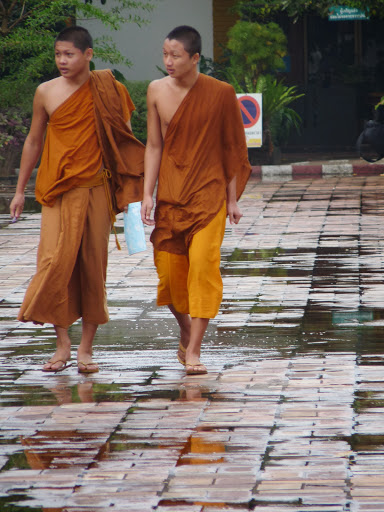
Young monks make a dash for cover in between torrential rain in the temple complex.

But the best bit (for me anyway) were the colourful animal statues dotted around the complex.

There were monkeys,cockerels, rats and more. I assume they were all signifying Chinese birth years.

This psychedelic critters made my day!

Couldn’t help myself, had to squeeze as many of the zany, multicoloured oddities in as possible!