As you mosey around the tiny hidden back streets of Chinatown you can’t help but virtually trip over ornate temples. Whether they are peeping from courtyards or standing bolshie and brash on the street corner.
Chinese temples host a wealth of decorative flourishes, from the detailed painting on the entrance gates to the exquisite, fantastical roof tableaux with dragons, flowers, waves and overwhelming colours.
Every inch of these places of contemplation is smothered in colourful, meaningful decoration.
Huge demon warriors watch over the faithful as well as glaring at snap happy tourists.
Temples are always some of my favourite photo opportunities.
First hopping off point of our Chao Phraya river cruise was Rajchawong Pier, this is the easiest pier for reaching Yaowaraj – China Town.
This fascinating area is a labyrinth of side streets, markets and stalls, selling everything from fresh fish, fruit and veg to all manner of dried meat and fish, dodgy sex toys, bike wheels, clothing, electrical items – in short anything you could ever want or need!!
Amazing jewellery store . . . so many many shiny things!
Unidentified frying food at some of the many many street food sellers
Neil is a little bewildered by the plethora of colourful tat!
Bags of beads, sequins, buttons and bows. A little girl’s dream!!!
Mobile porn stall! Not entirely sure if David is the stall holder’s name or its target audience. . . amusingly it is my dad’s name however . .
Selection of fresh food, from jewel bright pomegranates to a heap of slippery meaty stuff! Might be gizzards, liver, tripe . . who on earth knows!!!!!
Next up – more shots from our whistle stop tour of the river piers.
So it’s been a while. Been back in the good ole UK for well over a month now and only just getting around to recapping the amazing whirlwind tour of Thailand over Christmas.
On this second trip to the land of smiles we landed and left via Bangkok (that’s four visits now – feels like our Thai home from home!)
After being a little concerned by the ongoing unrest in Bangkok we were more than a little apprehensive. However we saw no trouble, standing on corner of Khao San Rd we heard some of the chanting but that was about it.
Back to the New Siam Riverside for our brief spot over in the hectic capital city. Still a lovely riverside spot but showing a few signs of wear and tear now.
As we only really had one full day in Bangkok, and we’d already seen a lot of the main sights four years ago, we decided to pay for a day ticket on the river ferry and just roam up and down the chao phraya river. 150 baht for unlimited rides on any of the boats, not too shabby!
Here’s a few random shots from our day on the river. Colourful garlands of flowers bring good luck to the skipper.
Wat Arun, Temple of the Dawn, as seen through a misty Bangkok morning
Hopping on the boat at Phra Arthit Pier behind our hotel, our first stop was almost all the way down the river to Rajchawong Pier – the gateway to Yaowaraj, China Town.
Lots of fantastic markets, piles of fruit, baked goods, clothing and all manner of curios. Photos coming up
It’s T minus three weeks until we jet off back to Thailand for three and a half weeks of heat, humidity, temples and beaches! WOO HOO!!!
Also mossies, sunburn and heat rash . . so OOOO NOOOO!!!!
First up we pay a return visit to the hectic, frenetic Bangkok and a second stay at the New Siam Riverside, so hoping for as good a stay as we had last time.
Then we’re flying North to Chiang Mai for more shiny cupolas and buddhas then you can shake a stick at. Plus three days jungle trekking, elephant riding, white water rafting and then bamboo rafting.
We”ll sleep out under the stars by a river for a night (Mossies are pricking up their ears .. if they have any) as well as spending an evening in a traditional jungle tribe hut too.
Then it’s a quick nip South to spend the xmas week in Phuket for some beach lolling and R and R.
Best start thinking about packing a bag, then unpacking, then repacking, then unpacking, and repeat . . .
The Spanish really love their fireworks and the bigger, louder, noiser and more war like the better!!
On our last night in Valencia we, along with about 7,000 locals, watched a midnight fireworks display. In three quarters of an hour they let off about three tonnes of fireworks!
It was more like being on the front line than a pleasurable experience. With ash and debris raining from the sky it was rather terrifying.
Even with a police corden keeping the crowds away from the dry river bed , the explosions still seemed uncomfortably close with some rockets only just clearing the nearby apartment block roofs!
The noise was epic. How I would expect standing near a ground to air missile when it detonates would sound! You could actually feel the whoosh of air knocking your legs backwards.
So many fireworks were set off that the actual explosions were obscured by the amount of smoke in the air.
All in all rather a fear inducing experience, and, with sore, ash filled eyes and ringing ears, we finally made our way back to our hotel.
Along the way we saw pretty much the whole city thronging the pavements, tooting their car horns and heading to the profusion of bars and cafes that were still open way into the earlier hours.
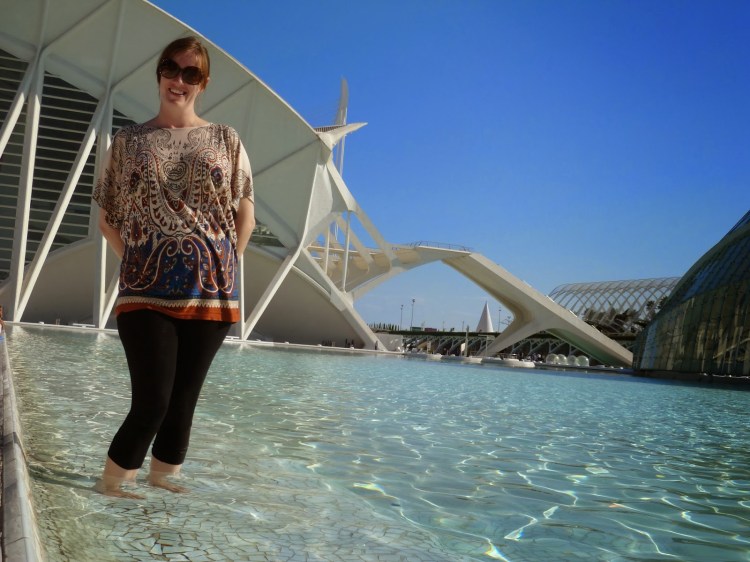
We took a leisurely stroll to see the futuristic City of Arts and Science.
There’s plenty to do inside the buildings if you’re feeling flush and have some dosh.
But it is equally worthwhile just to wander around the outside of the complex, gawking at the amazing buildings and soaking up the sun.
Kids scramble around in inflatable balls on the water, squeaking and flailing, while groups of teenagers try to sneak a toe into the tempting waters.
Set in the bed of the River Turia, this complex was designed by Santiago Calatrava and Félix Candela and is a dazzling white display of sci fi like buildings set in tempting pools of azure water.
Cooling as the water looks, you’re not allowed to paddle
A man in a golf cart whizzes around blowing a whistle if you try . . . . so of course we broke the law (a little).
The complex is made up of a variety of different buildings including the Hemisfèric (IMAX cinema and digital projections) designed to look like an eye floating on the water.
There’s also the Principe Felipe Science museum, the Oceanográfico (the largest aquarium in Europe with over 500 marine species) and the Palau de les Arts Reina Sofía.
The deep blue Agora hosts concerts, exhibitions and other things.
There’s also the Umbracle a landscaped vantage point and car park.
There’s a peaceful winter garden type affair to stroll through which is very welcome for a break from the sun and the crowds.
There are also some planet and astronomical type installments that you can try out.
We hopped on the train to Sagunt, a little town about half an hour from Valencia. Mainly to take a look at the castle at the top of the hill.
We trekked up the hill in the scorching heat, armed with supermarket picnic, ready for a cultural adventure
It was closed…
When will I ever learn. Spanish castles are never open. Here’s Neil in a hole instead
Here’s a bit of blurb, in lieu of any actual pictures of the inside!
Sagunto Castle covers an area of almost one kilometre in length. It was declared a National Monument in 1931.
So instead of the castle we had a roam through the back streets of Sagunt (which apparently used to be a city called Arse!!!)
Inside the main town the old Jewish quarter is a lovely, attractive quarter with narrow, cobbled streets, medieval houses and arches over the entrances to some streets.
It was the home of the Jewish community until they were expelled by the Catholics in 1492.
Here’s a traditional back street scene complete with Bouganvilla and cracking paintwork!
Here’s my latest image of the day. Taken in the market place in Jodphur again, after a busy few hours in the Clock Tower market place. A bustling, frenetic whirl of humanity, stalls and produce.
This little girl just happened to meet my gaze and her carefree grin is at striking odds with the physical load weighing her down.
It seems to be capturing the last vestige of an all too short childhood as she teeters on the threshold of an adult world that is already full of responsibility and toil.